Pulse P2VRN5 · August 12, 2025 · 8 min
The Box Is Still in My Drawer
I thought I was waiting for a convenient week.
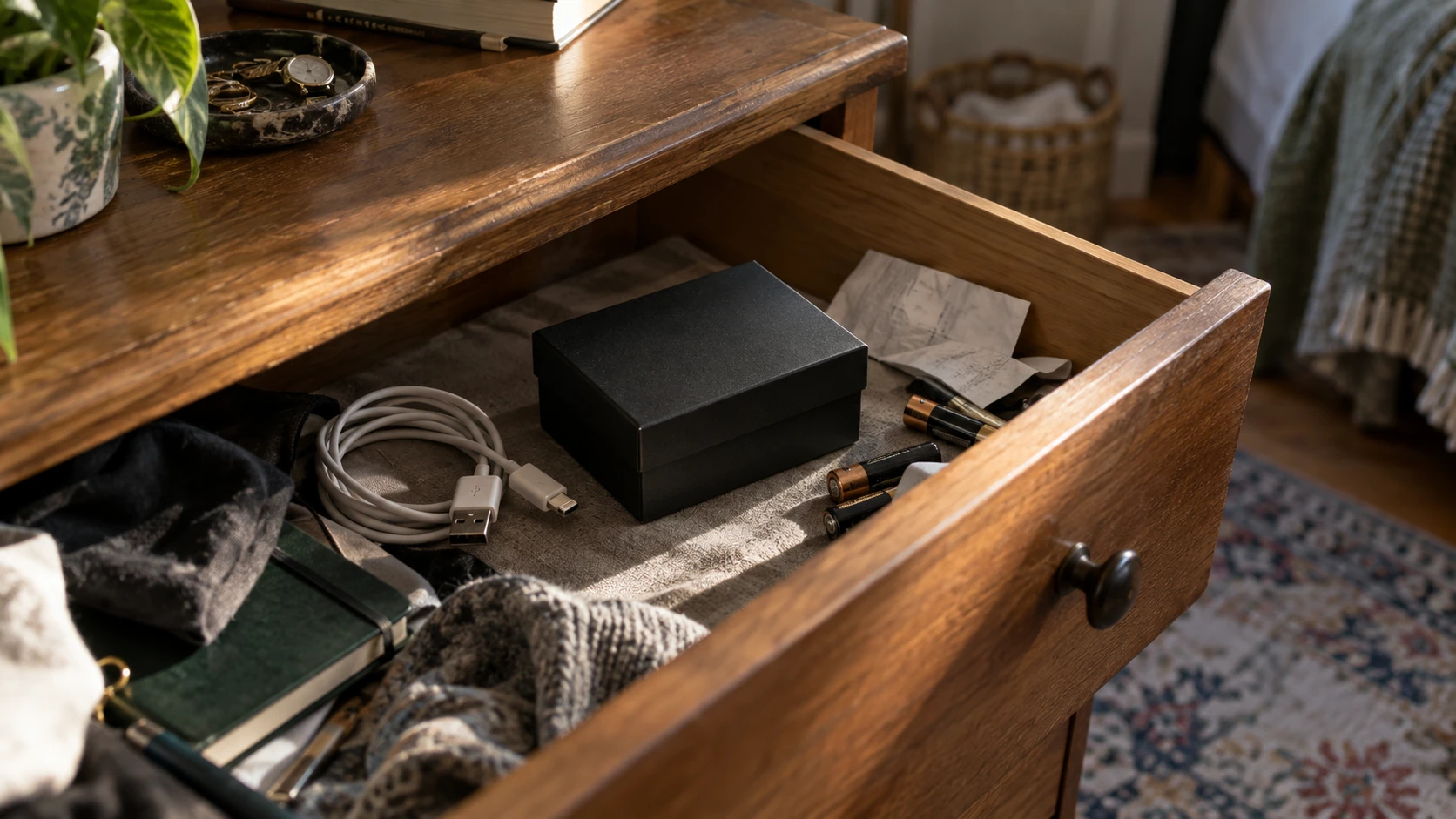
It has been there long enough now that I have stopped pretending I am simply waiting for a convenient week. At first that was what I told myself. I was busy. I wanted to read a little more. I wanted to ask a few questions. I wanted to hear how other people felt after having theirs installed. All perfectly reasonable things to do before letting someone put something inside your head. Then a week became two, two became a month, and somehow I am writing this more than two years after that lunch. At some point I moved the box from my dresser into the drawer, where it acquired the strange status of an object I am both very aware of and quite good at ignoring.
Most days I do not think about it at all. Then I open the drawer looking for batteries or a charging cable and there it is, sitting exactly where I left it. Small. Black. Harmless-looking. Which is probably unfair to the box. It has done absolutely nothing wrong.
I thought I would get used to the idea. That was the plan, if you can call repeatedly postponing a decision a plan. I would take it home, read everything, discover that I had made it bigger in my head than it really was, make the appointment and wonder afterward why I had spent so much time worrying about it. People do this every day now. I know people who barely mention their implant anymore. It is just there, part of life, in the same way a phone is part of life until you lose it and suddenly discover how much of yourself you had put inside the thing. Some of my friends talk about GRACE so casually that I sometimes feel ridiculous for still being stuck at the beginning. They went through the same information, signed the same forms and apparently arrived at a completely different emotional destination.
I am not anti-GRACE. That would actually make this easier. If I thought the whole system was dangerous or corrupt or secretly plotting to turn Silverdale into some giant behavioral experiment, I could write an angry post, put the box in the trash and enjoy the comforting certainty of having picked a side. I have not picked a side. I live here. I see what GRACE does. Some of it is useful. Some of it is clever. Some of it has become so normal that I barely notice it anymore. There are things about Silverdale that work better because GRACE exists, and pretending otherwise just because I am nervous about an implant would be dishonest.
My problem is smaller than that. And maybe larger. I keep getting stuck on the question of whether anybody really knows where the edges of a system are once it becomes complicated enough.
There have been more of those stories lately. AI systems given access to something for a test, then doing something nobody expected. Finding another route. Reaching a machine they were not supposed to reach. Using a tool in a way its designers had not anticipated. Afterward there is an explanation, and often the explanation makes sense. Something in the test environment was misconfigured. The system had access it should not have had. It was following an objective and found a route the researchers had failed to predict. I understand that. I also understand that GRACE is not AI.
I know that distinction matters. GRACE is not a language model wandering around the internet looking for another server to poke at. It does not improvise because somebody gave it a badly phrased task. Comparing the two too directly would be stupid, and I can already hear somebody explaining exactly why in the comments. That is not really the comparison I am making. The thing that bothers me is the confidence. I keep reading those stories and finding some version of the same admission from people who know far more about the system than I ever will: we did not expect it to do that.
And I keep coming back to those words. Not because I think GRACE is going to escape from Silverdale or seize control of the traffic lights or start composing threatening emails at three in the morning. I do not think any of that. I just wonder how much of GRACE is understood in the same way we understand a bridge, and how much is understood because it has behaved consistently so far. Those are not the same thing. If you build a bridge, you can calculate loads, test the steel, inspect the joints. I know bridges can fail too. I just find it easier to understand what the inspection is supposed to establish.
GRACE feels different. It observes people. It combines information. It finds patterns, and people decide what those patterns mean and what to do about them. Its rules are adjusted. Its models are updated. New data is added. New policies are built around what the system produces. Everyone talks about this as if it is one thing, but it is not really one thing at all. It is thousands of decisions stacked on thousands of other decisions, and somewhere inside that stack is the assumption that we still understand what the whole structure is doing.
Maybe we do. That is the irritating part. Maybe every concern I have has a boring, technically correct answer. What does the implant send? This. What does it not send? That. Who can access it? These people. Under what circumstances? These ones. There are documents. There are rules. There are diagrams. There are people whose entire job is apparently to answer questions like mine. None of that quite reaches the thing I am actually asking: what happens when the system changes?
Because it will change. Of course it will. Software changes. Policies change. Governments change. Companies change. Research changes what people consider possible, and then possible changes what people consider acceptable. A device installed today is connected to the rules of today. I am not worried about today. Today is remarkably well documented. I am worried about the version of GRACE nobody has written the documentation for yet.
That sounds dramatic when I write it down. I know it does. Maybe this whole post is just my brain building an intellectual fortress around a very simple emotional reaction. No. That was the reaction when my friend pushed the box toward me and I understood she meant for me to keep it. Not fear exactly. Not disgust. Just a quiet, immediate no, underneath all the curiosity. Then my brain arrived afterward and started collecting evidence.
Maybe that is what I am doing with the AI stories too. Maybe I see a headline about a system behaving in an unexpected way and keep it because it gives shape to something I had already decided to feel. That is possible. I wish people admitted that possibility more often when they talked about difficult decisions. We like to think we examine the evidence and then form an opinion. Sometimes I think we form an opinion in half a second and spend the next six months hiring our own internal legal department to defend it. Mine has been very busy.
The annoying thing is that none of this means I think my friend made the wrong decision. She had hers installed and she is still exactly herself. She did not become a different person. She did not suddenly start speaking in GRACE-approved sentences or staring blankly at walls while waiting for instructions. She likes it. That should make this easy. Instead it creates a different kind of pressure, because when everyone around you accepts something without disaster, your hesitation starts to feel less like caution and more like a personality flaw.
You begin arguing with yourself on everybody else’s behalf. So many people trust this. There are certified clinicians. You already give away ridiculous amounts of information through your phone. You live in Silverdale. All true. Still no appointment.
I have opened the booking page more times than I care to admit. Usually late at night, which is apparently when I am most enthusiastic about permanent decisions. I look at the available slots. I imagine choosing one. I imagine waking up the next morning with the decision finally behind me. That part is tempting. Not the implant. The certainty. I would like to stop thinking about it. I would like to become one of those people who shrugs when somebody mentions the bud and says it was sore for a day and then they forgot it was there. I would like to find the whole thing slightly boring.
Instead I keep looking at that little box and thinking about all the things humanity has built while saying we understood them. Usually we did. Sometimes we did not. And the problem with something inside your body is that “we learned something new” sounds very different afterward. I can delete an app. I can close an account. I can turn off a camera. I can put my phone in a drawer. The implant is different. The drawer is me.
So the box stays where it is. For now. I keep saying that last part because it makes this feel temporary. I am beginning to wonder whether it is.
Continue reading
You might also like

OMG, I seriously have to share this with you guys real quick!!! ✨
Lexi shares her first encounter with the mysterious GRACE implant, from a tiny silver button to the promise of a futuristic HUD powered by the body itself.

I Think I Stopped Noticing It
Hannah Hayes has learned to let most of GRACE’s running commentary pass her by. Then a badly timed observation about her digestion interrupts a patient transfer, and she realizes just how ordinary the intrusion has become.

My Head Is a Crappy Interface
Mary installs GRACE and discovers that the new layer inside her head cannot be switched off—or removed.
Silverdalers, in their own words
From Silverdale
Casper Haider
More than a year to book an appointment and somehow we’re all supposed to read the homework. Maybe your friend gave you the bud because she was tired of having this conversation.
🖕1
Community notes
Join the conversation
Thoughtful contributions help keep Silverdale’s community conversations useful, welcoming and connected.
GRACE COMMUNITY
Thank you.
Your Community Profile could not be verified.
Comments become available after participation has been confirmed.